Runner Coaster
- 4.3
- Rating
- 10.00M
- Installs
- Free
- Price
 Analysis by App-foxy
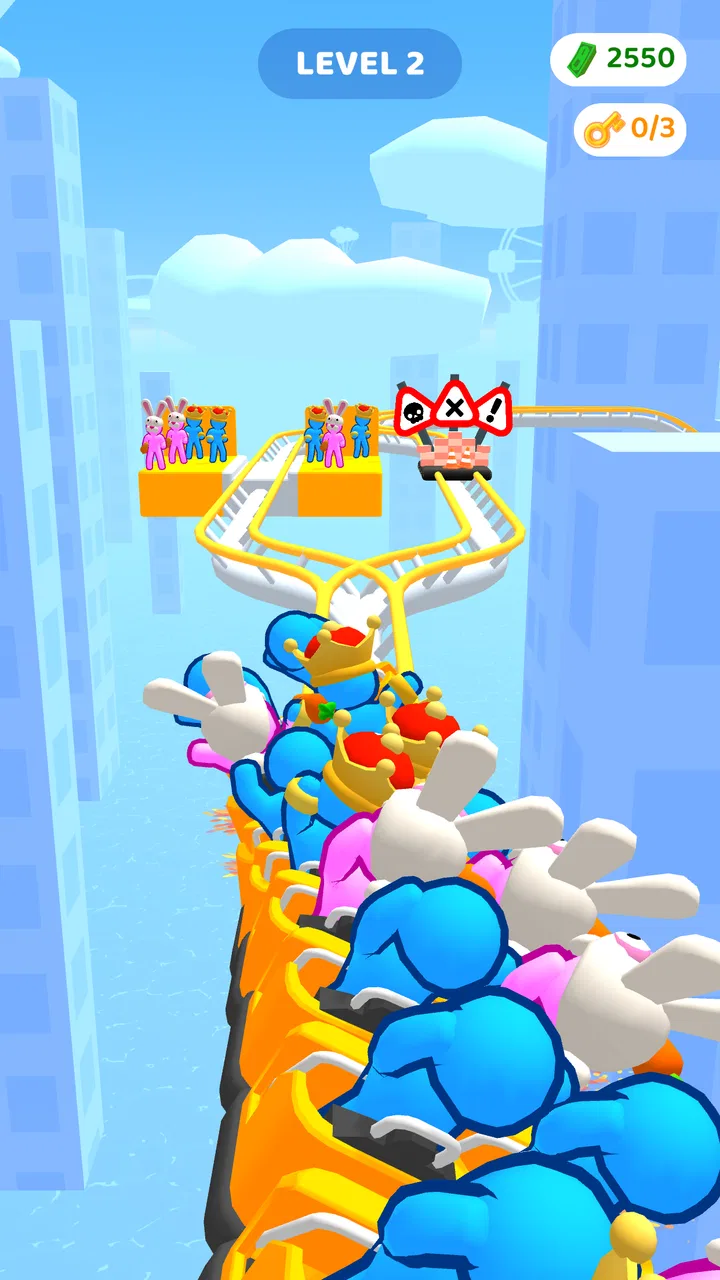
Runner Coaster is the kind of arcade game I open when I want something immediate rather than something I need to study. The idea is easy to understand: guide a roller coaster through a course and try to finish the ride. That simplicity is exactly what makes it approachable, but it also means the game lives or dies by the quality of its timing, feedback, and restart rhythm.
After spending time with it, I see the appeal clearly. The first action is quick, the result is visible almost at once, and a failed attempt naturally invites another try. It is a compact loop built around reaction and persistence, not a long campaign or a deep story. If you enjoy arcade games that ask for concentration in short bursts, this one is easy to recommend. If you want exploration, character development, or a large collection of systems to master, you may find it too narrow.
How the roller-coaster loop feels in practice
I find it helpful to judge each run by one decision rather than by whether I finish: notice where my attention slipped, then focus on that moment next time. That makes the coaster’s quick feedback feel more like practice than guesswork, especially when I only have a short break. It also sets up the bigger question of how much this focused loop offers beyond the immediate challenge.
You May Also Like

 Blood Strike: 2.5 Anniversary
Blood Strike’s Loadouts Turn Every Drop Into a Tactical Gamble
A close look at Blood Strike’s custom loadouts: how fast access to signature weapons reshapes its battle royale rhythm, rewards preparation, and narrows the gap between fights.

 Pandora - Music & Podcasts
Pandora’s Music Is Easy to Start, but Harder to Recover
Pandora’s strength is its low-effort path from a seed to a station. Its weak spot is how much confidence it asks you to place in connection, setup, and quiet recovery.

 8 Ball Pool
 Is Built on Rivalries, Rematches, and Routine
A close look at the rivalries, rematches, shared routines, and unanswered safety questions that turn a quick pool match into a persistent mobile community.

 Samsung Music
’s Quiet Strength Is Playing What You Already Own
Its reach comes less from spectacle than from dependable access to a personal library. That simplicity is both the app’s strongest retention engine and its ceiling.

 AccuWeather: Weather Radar
AccuWeather Review: A Quick, Clear Forecast for Everyday Decisions
For everyday plans, the best forecast is the one you can understand quickly. AccuWeather makes rain timing, radar, and local conditions easy to act on, with a few trade-offs.

 Hill Climb Racing
Why Hill Climb Racing Still Turns Crashes Into One More Run
A tiny car, a bumpy hill and one more upgrade: Hill Climb Racing keeps resurfacing because its simple chaos makes every near-miss feel personal.
More From Our News Desk



The first action is simple, but the timing matters
What I like most about the opening moments is that Runner Coaster does not make me wait before playing. The premise is immediately readable: the coaster is moving, the track presents a problem, and I need to react. That direct start suits a mobile screen, especially when I am playing for a few minutes between other tasks.
The controls are not interesting because they are complicated; they are interesting because a small input can have a large consequence. I have to watch the track, recognize what is coming, and act before the opportunity disappears. That creates a useful tension. The game gives me enough information to make a decision, but not enough time to overthink every movement.
This is where the arcade category fits Runner Coaster well. It is not asking me to build a strategy several minutes ahead. It asks me to stay present. My attention moves between the coaster, the next obstacle or change in the route, and the result of my latest action. That makes the game easy to pick up but harder to play consistently.
One practical tip is to avoid treating every moment as an emergency. My first instinct was to react as quickly as possible, but that was not always the best approach. Watching the rhythm of the course for a moment helped me distinguish between situations that needed immediate action and situations where a calmer response was safer. The game rewards attention more than frantic tapping.
Feedback gives each attempt its shape
The feedback rhythm is the strongest part of the experience. I make a move, the coaster responds, and I quickly learn whether that decision worked. That short distance between action and consequence keeps the game understandable. Even when I fail, I usually have a reasonable idea of what went wrong instead of feeling that the result was random.
That clarity matters in a game built around repetition. A restart only feels worthwhile when the previous attempt teaches me something. In Runner Coaster, the useful lesson may be as small as realizing that I reacted too late, held my attention on the wrong part of the track, or tried to correct a mistake instead of preparing for the next section. Those small observations build into better runs.
I also found that the game encourages a particular kind of concentration. I cannot play it well while constantly looking away, yet it does not demand the long, uninterrupted commitment of a larger action game. The ideal session is focused but brief. A quiet moment with the phone in hand works better than trying to play while walking, talking, or switching between several distractions.
The important feedback is not only success or failure; it is the explanation hidden in the timing of the mistake. Once I started paying attention to that timing, each attempt became more useful. Instead of simply hoping to finish, I began testing one adjustment at a time. That made progress feel earned rather than accidental.
Why another attempt feels worthwhile
The reward in Runner Coaster is mainly the satisfaction of getting farther and handling a section that caused trouble before. This is a modest reward, but it matches the scale of the game. I do not need a complicated progression system to understand why I want another run. The course itself becomes the challenge, and improvement becomes the payoff.
That design works particularly well for players who enjoy practicing a single skill. Some arcade games overwhelm the player with collectibles, upgrades, missions, and several currencies. Here, the central question stays much clearer: can I control the ride well enough to complete it? For me, that focus makes successful attempts feel cleaner.
There is also a useful emotional balance between failure and reward. A mistake ends the current effort, but it does not make the whole session feel wasted. I can immediately apply what I learned. This is the reason the game works as a short break: I can finish one attempt, understand the result, and decide whether I have enough patience for one more.
Still, the reward may feel limited if you need constant novelty. Runner Coaster is not the best choice for someone who expects a new mechanic every few minutes or a large narrative reason to keep playing. Its pleasure comes from refining reactions and reaching the end, not from collecting a broad range of long-term achievements.
The reset is part of the design, not an interruption
Restarting is central to the experience. When a run ends, the reset gives me a clean chance to try again while the mistake is still fresh in my mind. That short gap is important: if the restart were slow or cumbersome, the game’s main appeal would lose momentum. Here, the idea of another attempt feels natural because the previous attempt has just supplied a specific problem to solve.
I recommend using the reset deliberately rather than automatically. If I fail because I was rushing, immediately starting again at the same speed usually produces the same result. Taking a brief pause to identify the exact moment of failure is more useful. Did I notice the change too late? Did I make a correction that created a second problem? Did I stop watching the route because I was focused on the previous action? Asking one of those questions can turn repetition into practice.
This is also where the game may divide players. Some people enjoy the clean, retry-driven structure of arcade games. Others find repeated failure tiring, especially when they are looking for a relaxing ride rather than a demanding one. Runner Coaster can be satisfying, but it is not always calming. The roller-coaster theme suggests fun, while the actual experience asks for alertness and patience.
For an everyday scenario, I could see myself playing it while waiting for an appointment or taking a short break after finishing a task. I would not choose it when I had only enough attention for passive entertainment, because the timing still matters. I would also avoid starting a run when I knew I would be interrupted immediately. The game is short-session friendly, but each attempt still benefits from a few focused minutes.
What the current package means for players
Runner Coaster is free to download, which makes trying the core loop an easy decision. Optional in-app purchases are listed at $2.49 per item. That price point is worth knowing before installing, particularly for players who prefer games with no spending prompts at all. I would approach it as a free arcade experience first and decide for myself whether any optional purchase adds enough value.
The game is made by Dual Cat and has reached over ten million installs, with an average rating of 4.3 from around thirty-seven thousand ratings. Those figures suggest that the straightforward format has found a substantial audience, although popularity alone does not guarantee that its retry-focused style will suit everyone.
It carries a Teen content rating, so parents should check whether that fits their household expectations before handing it to a younger player. The game runs on Android version 7.0 or later. It was released on May 20, 2022, and the current version is 2.5.6, details that are useful when checking compatibility on an older device.
I would not choose a game solely because it has a high install count or a solid average score. In this case, those details support what I experienced: Runner Coaster is accessible enough to attract many players, but its real value depends on whether you enjoy repeating a course to improve your timing. The store summary asks whether you can finish the roller coaster, and that question is more important than the theme itself.
Where it stands beside other arcade choices
Compared with an endless runner, Runner Coaster feels more focused on solving the immediate route than on surviving for as long as possible. Endless runners often build their appeal around distance, speed, and a stream of changing hazards. This game feels more like a compact challenge with a clear finish in mind. That difference makes it a better fit for someone who wants a defined objective, but a weaker fit for someone who enjoys watching a score climb through an endless session.
Compared with puzzle arcade games, it demands quicker reactions and offers less time to plan. A traditional puzzle game may let me pause over a move and consider several possibilities. Runner Coaster instead asks me to read the situation while the ride continues. Players who enjoy immediate physical timing may prefer it; players who want deliberate problem-solving may find a puzzle alternative more comfortable.
It also differs from larger coaster or theme-park games that focus on construction, customization, or management. Runner Coaster is not about designing the attraction or running an amusement park. Its satisfaction comes from controlling the ride itself. That narrower purpose is a strength when I want action without menus, but it is a limitation if creative building is the main reason I like roller-coaster games.
One of the less obvious trade-offs is that the simple premise places more pressure on execution. There are fewer distractions to hide a weak moment in the core gameplay. If the timing feels good to you, the minimal approach is refreshing. If it does not, there is not a large world or story to compensate. I would therefore try it with the expectation of testing a focused arcade loop, not entering a broad adventure.
Who will get the most from it
I think Runner Coaster is best for players who like quick retries, visible improvement, and challenges that can be understood without a tutorial-heavy introduction. It is a good match for someone who enjoys learning through mistakes and wants a game that can be opened for a short session without losing its identity.
It may also suit players who normally avoid complex mobile games. There is no need to learn a large set of systems before discovering whether the game is enjoyable. The first attempt tells me what kind of attention it requires, and the following attempts give me a clear way to improve: react earlier, read the course more carefully, and avoid repeating the same rushed decision.
I would be more cautious recommending it to someone who wants a relaxing idle experience, a story-driven game, or a deep progression system. I would also skip it if repeated failure quickly becomes frustrating. The game’s loop depends on accepting that a failed run is useful information. Without that mindset, the reset can feel like a chore instead of an invitation.
For younger players, the Teen rating should be considered before installation. For people with older Android devices, the minimum operating-system requirement is another practical check. Those details do not change the gameplay, but they can determine whether the app is appropriate for the intended player and device.
My verdict on the action-feedback-reward loop
Runner Coaster succeeds because its loop is easy to describe and easy to feel. I act, watch the coaster respond, recognize the result, and decide whether I can do better. The reward is not complicated: reaching farther, correcting a mistake, and eventually finishing the ride. Then the reset turns failure into the starting point for another experiment.
That structure is both the game’s main strength and its clearest limitation. It stays focused, but it does not offer much outside the central challenge. I appreciate that honesty. The game does not need to become a management simulator or a story adventure to be worthwhile; it simply needs to make the next attempt feel fair and meaningful.
My recommendation is to try it if you want a free arcade game for concentrated bursts and enjoy the satisfaction of improving through repetition. Start with a patient approach, watch when mistakes happen, and do not confuse fast reactions with good timing. If you are searching for a richer alternative with building, exploration, or a more relaxing pace, another genre will probably serve you better.
For me, Runner Coaster is most successful when I treat each run as a small test rather than a demand to win immediately. The next session begins because the last one showed me exactly what I still need to learn. That is a simple reason to keep playing, and in an arcade game, it is often the right one.
FAQs for Runner Coaster
01What is Runner Coaster and how does the gameplay work?
Runner Coaster is an arcade-style mobile game that combines endless running with roller-coaster movement. You guide a character or cart along a constantly moving track, collect items, avoid obstacles, and try to reach the highest score possible. The controls are generally simple, making it easy to start playing, although later sections can require quick reactions and careful timing.
02Is Runner Coaster free to download and play?
Runner Coaster can typically be downloaded and played without an upfront purchase, which makes it accessible for casual players. However, the game may include optional in-app purchases, advertisements, or other monetization features. Before downloading, it is worth checking the store listing for the current pricing details, available purchases, and whether certain boosts, cosmetic items, or extra features require payment.
03Does Runner Coaster require an internet connection?
The basic gameplay experience may work without a constant internet connection, which is useful when traveling or playing in areas with limited coverage. Nevertheless, some functions may depend on connectivity, including advertisements, online leaderboards, cloud saving, updates, or promotional content. If offline play is important to you, test the game in airplane mode after installation to see which features remain available.
04Is Runner Coaster suitable for children and casual players?
Runner Coaster is generally easy to understand because its gameplay focuses on straightforward movement, obstacle avoidance, and score chasing. It can be suitable for children and casual players, but parents should still review the age rating, advertising content, and in-app purchase settings. Fast-paced sections may also become challenging, so younger players could need help with controls or purchase restrictions.
05What devices are compatible with Runner Coaster, and does it run smoothly?
Compatibility depends on the version available for your Android or iOS device, as well as the operating system requirements listed in the official app store. On newer phones and tablets, the game should usually provide responsive controls and smooth performance. Older or entry-level devices may experience slower loading, reduced visual quality, or occasional performance issues, so checking the latest requirements before installing is recommended.
Pros
- Simple controls make the game easy to pick up and play.
- Fast-paced levels provide short bursts of entertaining gameplay.
- Bright visuals and coaster-themed tracks create a playful atmosphere.
- Collectibles and obstacles add variety to each run.
- Works well for quick sessions when you have limited free time.
Cons
- Gameplay may become repetitive after extended play sessions.
- Frequent obstacles can feel frustrating when progress depends on timing.
- Some levels may lack enough challenge for experienced players.
- Performance can vary on older or less powerful devices.
- Ads or optional purchases may interrupt the overall experience.

Runner Coaster
Gallery